

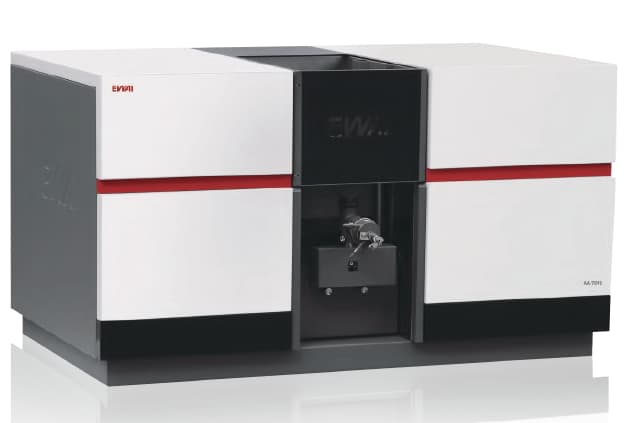
- AA-7090 is the fifth-generation atomic absorption spectrometer developed by EWAI. It combines the quality and precision that EWAI is known for with important new features.
- The AA-7090 graphite furnace features a unique design with transverse heating, longitudinal Zeeman background correction and variable magnetic field intensity.
- The Zeeman background correction is suitable for high precision analysis of samples with complex interference matrices.
- Variable magnetic field intensity allows the operator to optimize field strength for each element, maximizing the Zeeman effect for accurate results every time.
SPECIFICATION
Optics
- Wavelength Range: 190 nm to 900 nm
- Bandwidth: 0.1, 0.2, 0.4, 1.0, and 2.0 nm (automatic switch)
- Monochromator: Czerny-Turner Grating
- Wavelength Accuracy / Indication Error: ± 0.1 nm
- Wavelength Repeatability: ≤ 0.05 nm
- Grating: 1800 lines / mm
- Blaze Wavelength: 250 nm
- Baseline Stability: Static baseline stability ≤ 0.002 A / 30 min, dynamic baseline stability ≤ 0.003 A / 30 min
- Resolution: Better than 0.1 nm
Flame System Characteristics
- Concentration of Cu: ≤ 0.02 μg / mL / 1%
- Detection Limit: ≤ 0.003 μg / ml
- RSD: ≤ 0.45%
- Burner Head: Switchable 50 mm and 100 mm titanium burner head, titanium nebulizer, and high-performance glass nebulizer
- Position Control: Optimization of height and angle, flame and hydride switch within one minute
Graphite Furnace System Characteristics
- Concentration of Cd: ≤ 0.5×10⁻¹² g
- Detection Limit: ≤ 1×10-12 g
- RSD: ≤ 3.0%
- Temperature Control: Max 20-step temperature program with 3 temperature rise modes (step, slope, and flat)
- Heating Mode: Power heating
- Heating Rate: ≥ 2500℃ / s
Background Correction
- Background correction is available for both flame and graphite furnace methods. Deuterium lamp for flame. deuterium lamp or Zeeman for graphite furnace.
- Correction Mode: Deuterium lamp, Zeeman Correction Capability:
- Deuterium Lamp: When background absorption approaches 1.0 Abs, the instrument is capable of a background correction of 60 times or more.
- Zeeman: When background absorption approaches 2.0 Abs, the instrument is capable of a background correction of 100 times or more.